

It happened near the end of November. A Las Vegas family had spent weeks sorting through clothing, toys, and household goods things their children had outgrown and items collecting dust in the garage. They drove it all to a local children’s charity, dropped everything off, and felt good about it. Then tax season arrived, and they realized they had no receipt, no acknowledgment letter, and no way to claim any of it. The deduction was gone.
That scenario plays out more than most people realize. Knowing how to donate to a 501(c)(3) and properly claim a tax deduction isn’t complicated but there are specific steps that must be followed.
Quick Summary
– Only donations to IRS-recognized 501(c)(3) organizations are tax-deductible.
– You must itemize deductions (or, starting in 2026, qualify under new OBBBA rules) to claim the benefit.
– Always get written documentation a receipt, bank record, or acknowledgment letter.
– Donations of $250 or more require a written acknowledgment from the charity.
– Verify any charity’s status using the IRS Tax Exempt Organization Search tool before giving.
What Is a 501(c)(3) Organization?
The number refers to a section of the IRS code that exempts qualifying nonprofits from federal income tax and allows donors to deduct their contributions.
These groups operate for charitable, religious, educational, scientific, or other approved purposes and donations to them may be tax-deductible.
Not every nonprofit qualifies.
In order for a donation to be deductible, it must go to a qualified nonprofit organization approved by the IRS most often religious, charitable, or educational organizations. However, a deduction may also be available for gifts to other types of organizations, such as a local volunteer fire department or a group that prevents cruelty to animals.
The most straightforward way to confirm a charity’s status is a quick database check.
Donors can confirm any organization’s tax-exempt status using the IRS’s Tax Exempt Organization Search tool.
If an organization fails to file required information for three consecutive years, it automatically loses its tax-exempt status which means donations made to it can’t be deducted. It’s a good idea to check an organization’s status before filing a tax return.
Who Can Claim a Donate-to-501(c)(3) Tax Deduction?
This is where many donors get tripped up. The deduction isn’t automatic.
Charitable contributions to an IRS-qualified 501(c)(3) can only reduce a tax bill if the taxpayer chooses to itemize. Generally, itemizing makes sense when the combined total of anticipated deductions including charitable giftsadds up to more than the standard deduction.
But the rules are shifting.
Beginning with the 2026 tax year, under the One Big Beautiful Bill Act (OBBBA), donors can deduct up to $1,000 in cash gifts to qualified public charities ($2,000 for joint filers) even when taking the standard deduction.
If itemizing, charitable contributions are tax-deductible only if they exceed 0.5% of the filer’s adjusted gross income (AGI) a new provision that creates a “floor” on what’s deductible.
For those who do itemize, the limits can be significant.
In general, donors can deduct up to 60% of adjusted gross income via charitable donations, but may be limited to 20%, 30%, or 50%, depending on the type of contribution and the organization.
Contributions that exceed the limit can often be deducted from tax returns over the next five years through a process called a carryover.
What Types of Donations Qualify?
Cash is the simplest option.
Cash donations, including those made by check, credit card, or electronic transfer, are the most straightforward category.
But donors aren’t limited to dollars.
Many 501(c)(3)s accept more than cash stocks, real estate, and goods may also qualify as charitable contributions.
In addition to cash contributions, donors can generally deduct the fair market value of any other property donated to qualified organizations.
Non-cash donations carry additional requirements, though.
Donors must fill out Form 8283, Noncash Charitable Contributions, if the deduction for any noncash contribution exceeds $500. For deductions between $500 and $5,000, Form 8283 Section A applies. For deductions over $5,000 per item, a qualified appraisal is also required.
Some contributions, however, don’t qualify at all.
Donations to political candidates, political parties, PACs, or campaign committees are explicitly excluded. Contributions where the donor received something of equivalent value in return such as event tickets or merchandise are only partially deductible, and only the amount exceeding the fair market value of what was received qualifies.
The IRS Nonprofit Donation Rules Around Documentation
Think of documentation the same way one might approach a paper trail for a business expense. Without it, the deduction simply doesn’t hold up.
For contributions of cash, check, or other monetary gifts regardless of amount donors must maintain a record of the contribution: a bank record or a written communication from the qualified organization containing the name of the organization, the amount, and the date of the contribution.
The threshold for more formal documentation is $250.
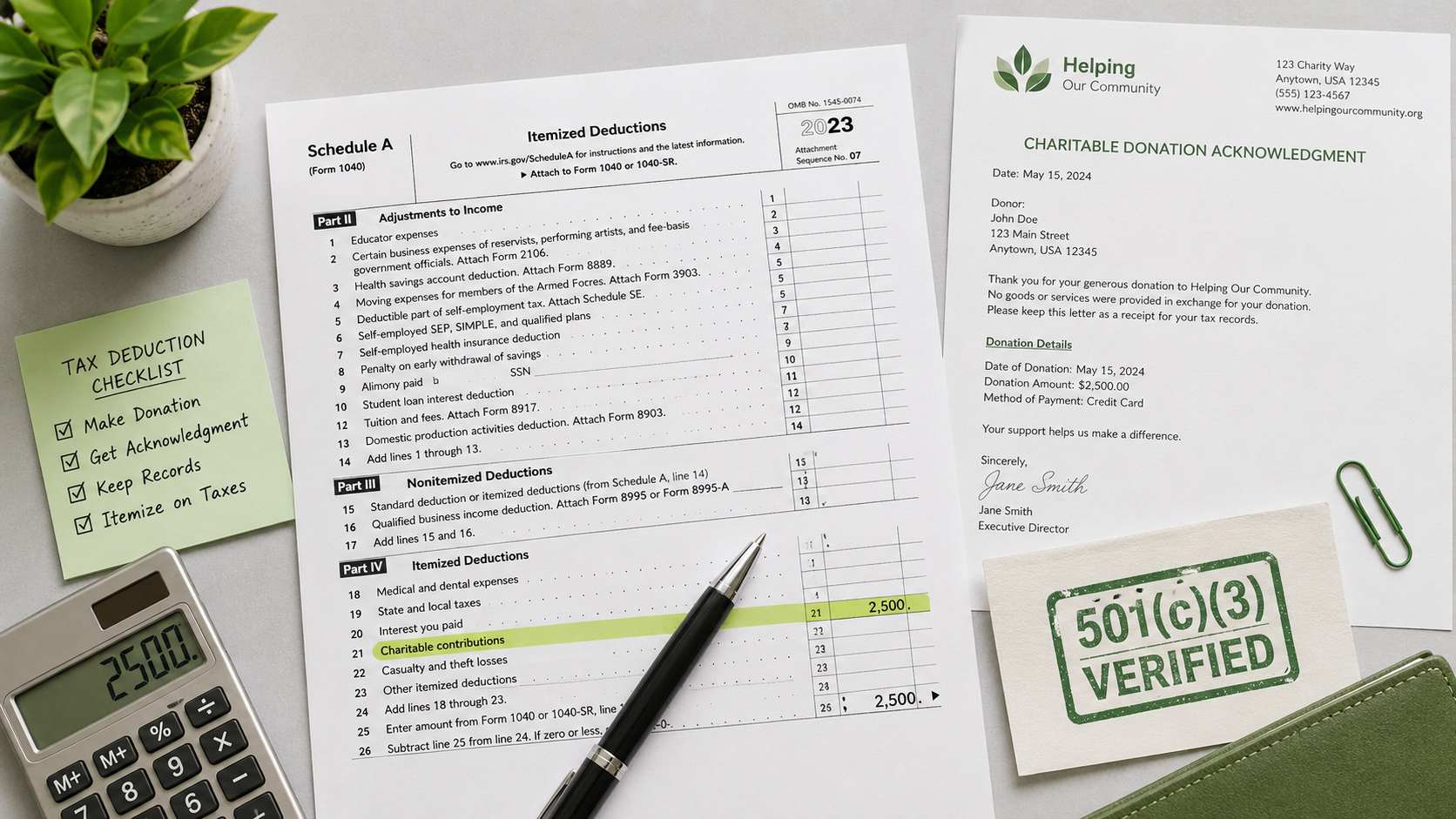
For any contribution of $250 or more, donors must obtain and keep a contemporaneous written acknowledgment from the qualified organization indicating the amount of cash and a description of any property contributed. The acknowledgment must state whether the organization provided any goods or services in exchange for the gift and, if so, provide a description and good faith estimate of their value.
Donors must receive this letter of acknowledgment by the date they file taxes for the year the contribution was made.
There’s also a timing rule that catches donors by surprise.
Contributions must actually be paid in cash or other property before the close of the tax year to be deductible, whether the cash or accrual method is used.
For year-end charity donations in Las Vegas or anywhere else, that December 31 deadline is firm.
How to Actually Claim the Charitable Giving Tax Benefit on a Return
The mechanics are straightforward once the documentation is in order.
Charitable contributions to qualified organizations may be deductible when itemizing deductions on Schedule A (Form 1040).
Donors include the sum of charitable donations made within the tax year using IRS Form 1040 Schedule A on lines 11 and 12. Carryover amounts from previous years are entered on line 13.
The process for claiming a tax-deductible children’s charity donation or any other qualified gift follows the same path: verify the organization, make the donation before December 31, keep all documentation, and report it properly on Schedule A. That’s the full loop.
FAQ: Donating to a 501(c)(3) and Tax Deductions
Q: Can someone donate to a 501(c)(3) and get a tax deduction without itemizing?
There is a charitable deduction for non-itemizers beginning with the 2026 tax year. It’s capped at $1,000 ($2,000 for joint filers) and is only available for cash donations.
For prior tax years, itemizing was required.
Q: What happens if a donor gives more than the deduction limit in one year?
If donors reach their limit and still have gifts to deduct, they may be able to claim these deductions in future years, for up to five years, in what’s known as a carryover.
Q: Are donations of goods like clothing or toys tax-deductible?
Clothing or household items must be in at least “good used condition.” Donors can deduct only the value they would sell for in a thrift shop not the original purchase price.
Donors claiming over $500 in noncash items must also complete Form 8283.
Make Every Charitable Dollar Count
Giving to a cause matters. And when it’s done correctly, it can also reduce a tax bill whether the gift supports a local tax-deductible children’s charity, a religious organization, or a community nonprofit in Las Vegas. The charitable giving tax benefits are real and worth claiming.
The steps aren’t difficult. Verify the organization. Give before December 31. Keep the receipt or acknowledgment letter. File Schedule A. That’s it.
If you’re ready to make a meaningful contribution this year, start by confirming your chosen charity’s status on the IRS Tax Exempt Organization Search tool then give with confidence. Consider reaching out to a qualified tax professional for guidance specific to your financial situation, as individual circumstances can affect deduction limits and eligibility.
*This article is for informational purposes only and does not constitute tax or legal advice. Always consult a qualified tax professional regarding your specific situation.*